
Village Bundle Programming
Most mixed-use programs are assembled. A residential pro forma, a retail assumption, a hotel if the site seems to warrant one, and amenities chosen to support the residential.
Village Bundle Programming starts from a different question: not what each use returns on its own, but what each use does for the others and in what order they have to arrive. Residential, hospitality, grocery, wellness, food and beverage, office, and destination retail, staged so each one creates demand for the next. The bundle is evaluated, phased, and sized against real demand engines in the trade area, not assembled from a generic town-center template.
What Gets Bundled, and Why
Each component carries a specific economic job:
Residential (Lead) — the base-load value engine, establishing the daily rooftop count everything else depends on.
Wellness, Fitness, F&B (Lead) — the low-threshold, high-frequency layer that seeds the place ahead of destination retail.
What Triggers It
HSG evaluates a site against three demand engines — base demand (rooftops and daily routines), peak demand (corporate, group, and leisure drivers), and place premium (third-place programming that converts presence into frequency, dwell time, and spend capture). A full village bundle is warranted only when all three are present and reinforcing.
In practice, that shows up as five signals: demonstrated leakage, a quality or format gap, a credible rooftop trajectory, behavioral segmentation that favors daily-spend lifestyle segments, and a site capable of functioning as a center — or of complementing a larger destination nearby rather than competing with it.
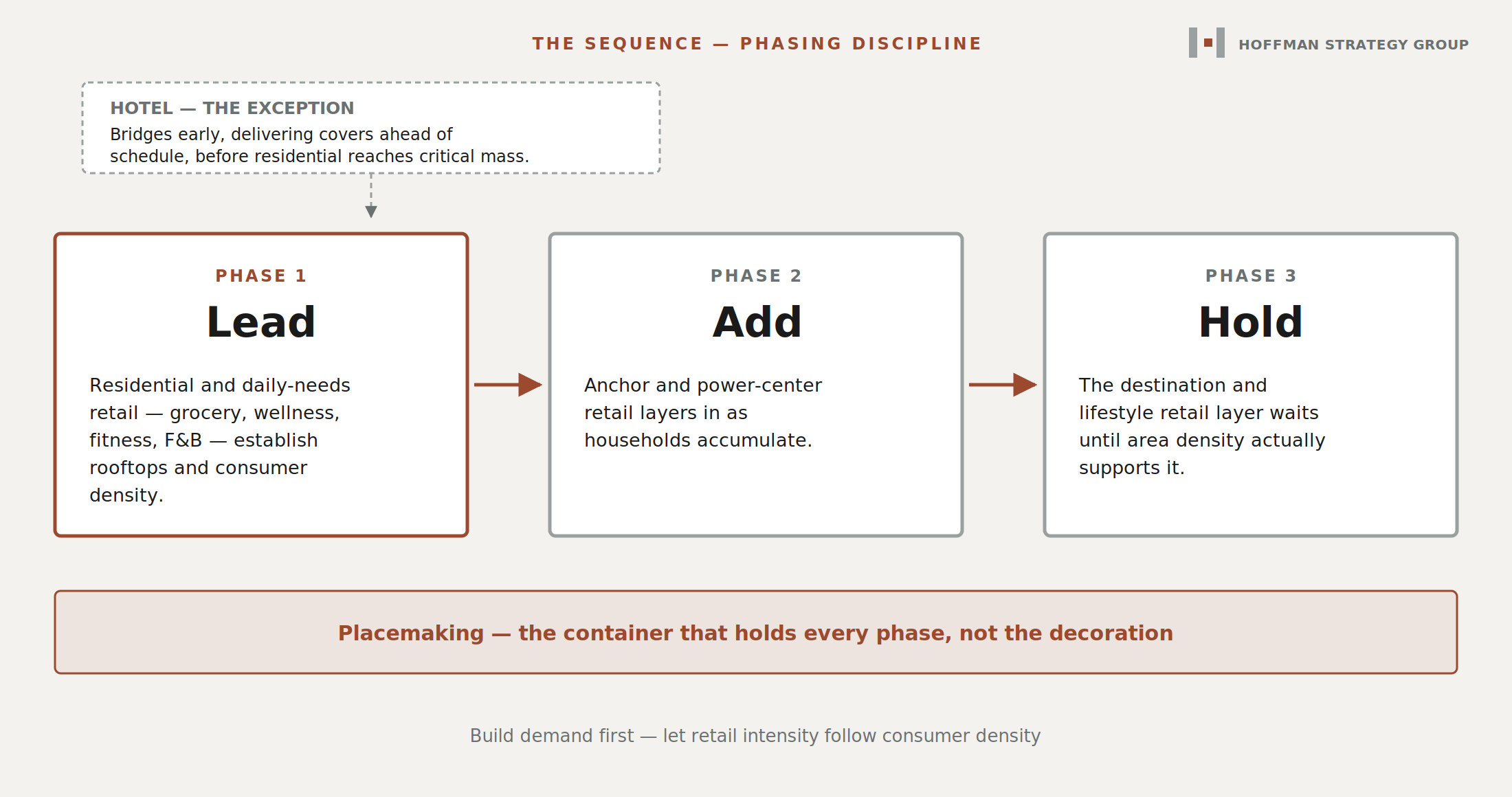
Hotel (the exception, bridges early) — the demand bridge, front-loading covers and public-space energy before the resident population reaches critical mass.
Destination / Specialty Retail (Hold)— the regional-draw layer, which follows rather than leads.
Grocery / Specialty Grocer (Lead) — the village anchor, driving daily trips and dwell time.
Office (Add) — proximity in a hybrid-work era, covering the daypart residential and hotel don't.
Placemaking — the container, spanning all three, not the decoration.
The discipline is to build demand first and let retail intensity follow consumer density: lead with residential and daily-needs retail, add anchor retail as households accumulate, and hold the destination layer until density supports it.
Commissions
Village Bundle Programming is commissioned work. Each engagement is built for one place.
Utah City in Vineyard, Utah. A downtown programmed from open ground on the eastern shore of Utah Lake, with Torti Gallas + Partners.
The same diagnostic reads correctly outside suburban, rooftop-driven growth. At Hyde Park in Chicago, an institutional anchor — not a rooftop curve — triggered the read, closing the largest leakage gaps with daily-needs anchors before hospitality followed.
At 85 Jay Street in DUMBO, Brooklyn, peak demand was tourism and tech employment, verified with geofenced mobile-location data rather than population projections.
At Riverton, New Jersey, the diagnostic read a post-pandemic right-sizing of an already-approved plan — demand had shifted, not disappeared. (The full case record on Outcomes.)
The Work Behind It
Village Bundle Programming is the applied output of the Five-Step Methodology Framework — Jerry Hoffman's application of Social Fabric Matrix theory, established by F. Gregory Hayden, to real estate development. It draws on Central Place Theory, spatial economics, and the trade area ladder, and takes its organizing idea from the intersection of people, commerce, and place.
Applying it to a site is a guided process conducted directly by Hoffman Strategy Group.
Start a Commission
If you have a site and a question about what it can carry, that's the conversation.