
The Physics by Which People · Commerce · Place Generates Economic Value
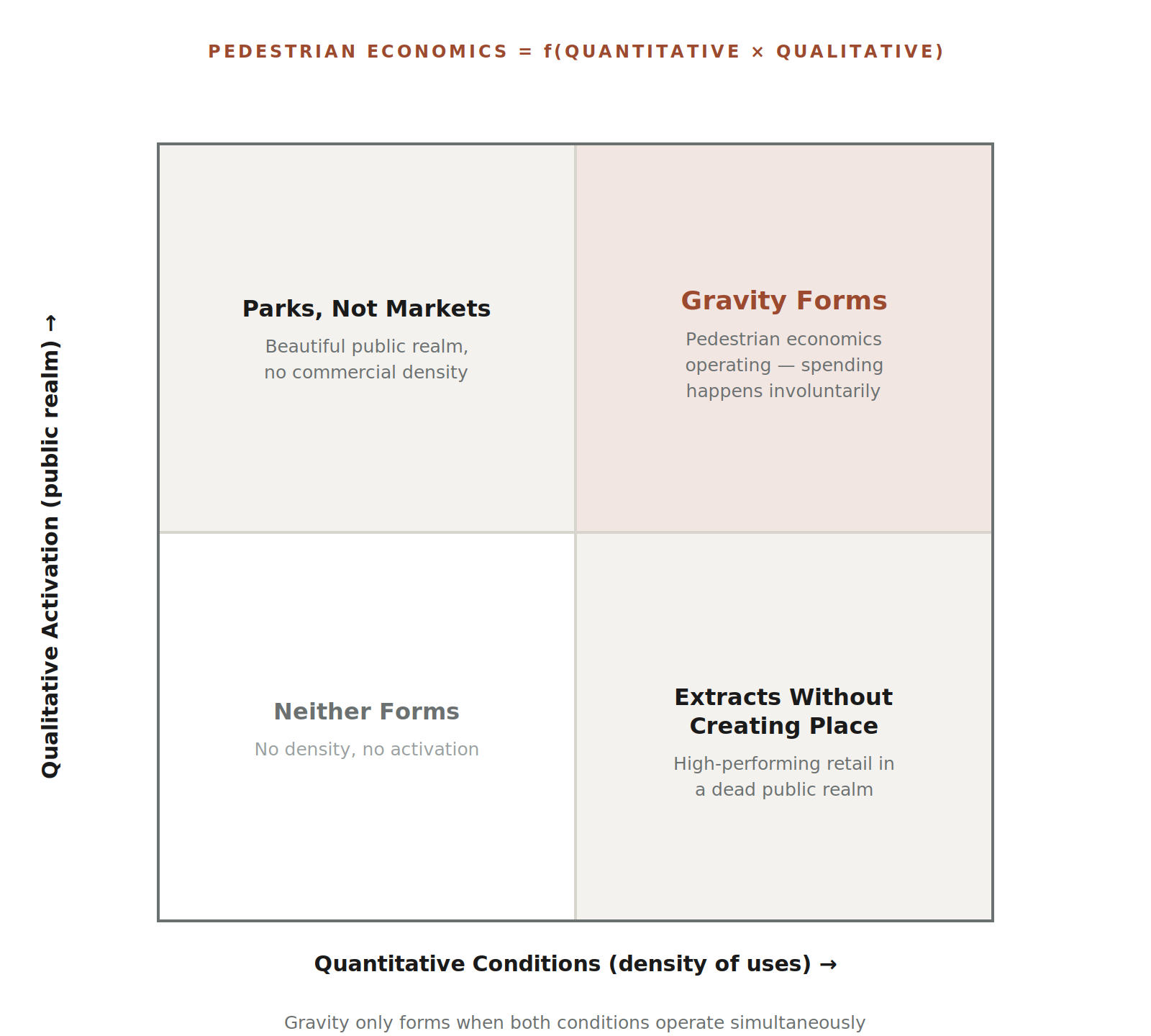
Pedestrian economics describes the friction-reduced, discovery-driven, impulse-responsive commerce that happens when people move slowly through a place on foot. It is not foot traffic — that's a metric. It's an economic condition created by the right density of uses, the right spatial sequence, and the right mix of everyday and aspirational programming. When it's operating, spending happens almost involuntarily. When it's absent, even great destinations underperform.
Why Neither Half Works Alone
Quantitative conditions without qualitative activation — high-performing retail in a dead public realm. It extracts value without creating a place.
Qualitative activation without quantitative conditions — a beautiful public realm without commercial density. It produces parks, not markets.
Gravity only forms when both are operating simultaneously — the same imbalance shows up at the destination-draw level, not just the use-mix level: destination draw without pedestrian economics produces a one-trip experience, and pedestrian economics without destination draw produces a neighborhood locals love but visitors never find.
How HSG Applies It
People · Commerce · Place describes the intersection. Pedestrian Economics describes the mechanism by which that intersection generates economic value — one is the architecture of the framework, the other is the physics by which it operates. Its density-sequencing principle is the likely source of Village Bundle Programming's own phasing discipline: residential and daily-needs uses establish local density before destination uses layer in, because the broader market has to believe a place is real before it will show up for the destination piece.
See People · Commerce · Place, the framework this mechanism operates inside.
See the core Village Bundle Programming methodology.
Back to the six frameworks.
People · Commerce · Place, Village Bundle Programming, the trade area ladder, Central Place Theory applied to modern trade areas, Pedestrian Economics, and the Five-Step Methodology Framework are original methodologies of Jerry Hoffman, attributed to Hoffman Strategy Group. The Sumerian "Y" is a historical ideogram documented by Lewis Mumford, drawing on S.N. Kramer's translations — see the dedicated Sumerian "Y" document for its extension into HSG's organizing framework.