
The Foundation Everything Else Is Built On:
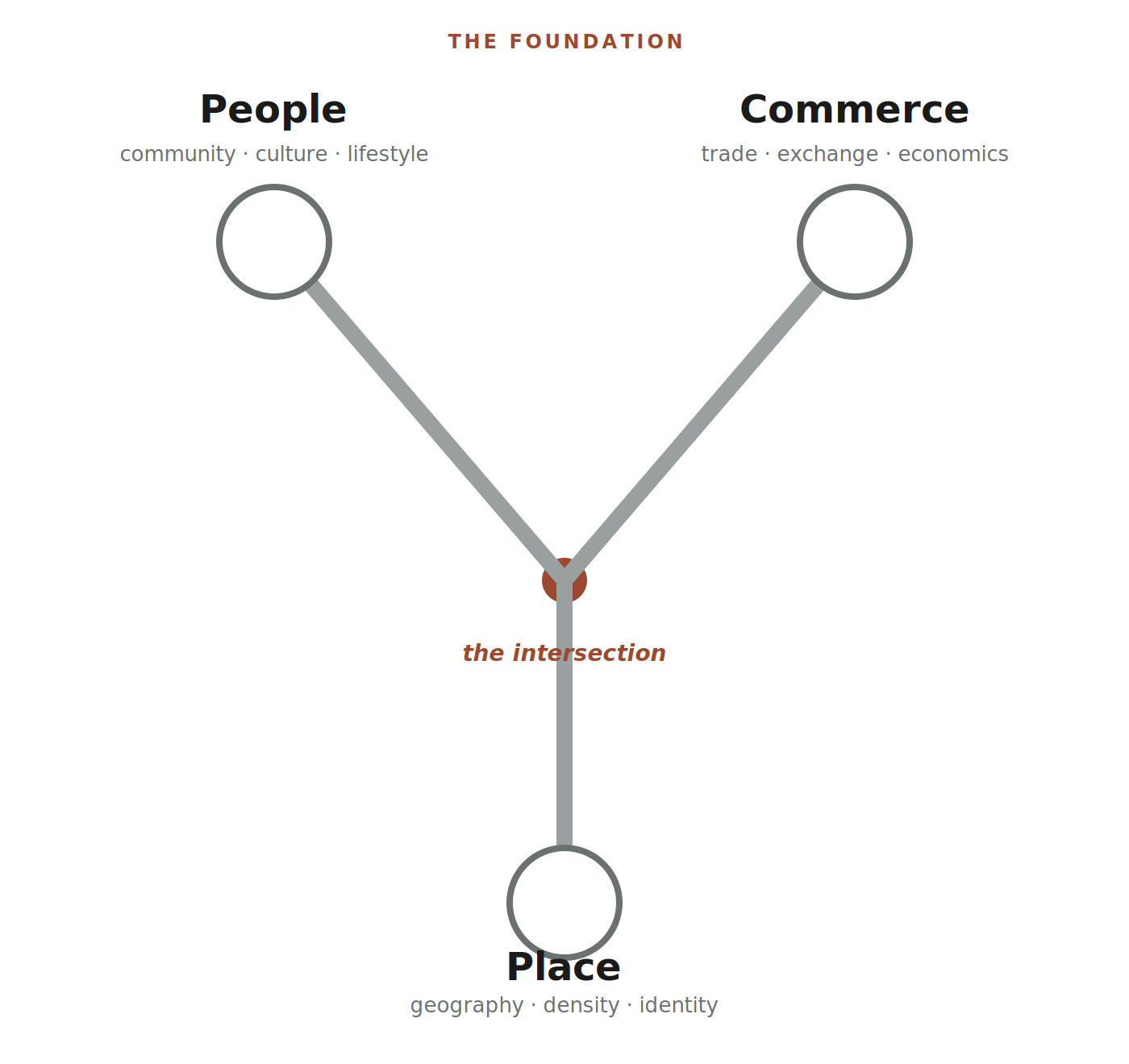
At the heart of HSG's methodology is a simple and ancient idea: the intersection of people, commerce, and place. Every market analysis HSG conducts begins and ends with this framework. Scale changes. Context changes. The underlying forces do not — Central Place Theory, agglomeration economics, the gravity effect, and psychographic alignment all operate whether or not anyone in the room knows their names. The methodology makes these forces visible, and actionable.
The Three Forces:
People — community, culture, and lifestyle: who is present, how they live, what they value.
Commerce — trade, exchange, and economics: the spending, pricing, and demand that make a place viable.
Place — geography, density, and identity: the physical and cultural ground the other two forces take shape in.
None of the three functions alone. A place with people but no commerce is a residential subdivision. Commerce without people is vacant retail. People and commerce without a place that can hold them is a transaction, not a community.
Where It Comes From:
The Sumerian "Y" is the symbolic root of this framework — the point where commerce, community, and place intersect. It's not a decorative reference: the underlying idea of three forces converging into one point is the same one the symbol has carried for thousands of years.
Read the full origin story.
The Parent Framework:
This is not one methodology among others in HSG's portfolio — it's the parent. Village Bundle Programming is the applied expression of People · Commerce · Place at the site and bundle scale: a direct parent-child relationship, not a downstream connection. The Five-Step Methodology Framework is how HSG reads the three forces at a given site; Village Bundle Programming is what gets built once they're read.
See the core Village Bundle Programming methodology
See the Five-Step Methodology Framework
Back to the six frameworks
People · Commerce · Place, Village Bundle Programming, the trade area ladder, Central Place Theory applied to modern trade areas, Pedestrian Economics, and the Five-Step Methodology Framework are original methodologies of Jerry Hoffman, attributed to Hoffman Strategy Group. The Sumerian "Y" is a historical ideogram documented by Lewis Mumford, drawing on S.N. Kramer's translations — see the dedicated Sumerian "Y" document for its extension into HSG's organizing framework.