
Not a Methodology — the Origin Story Behind One
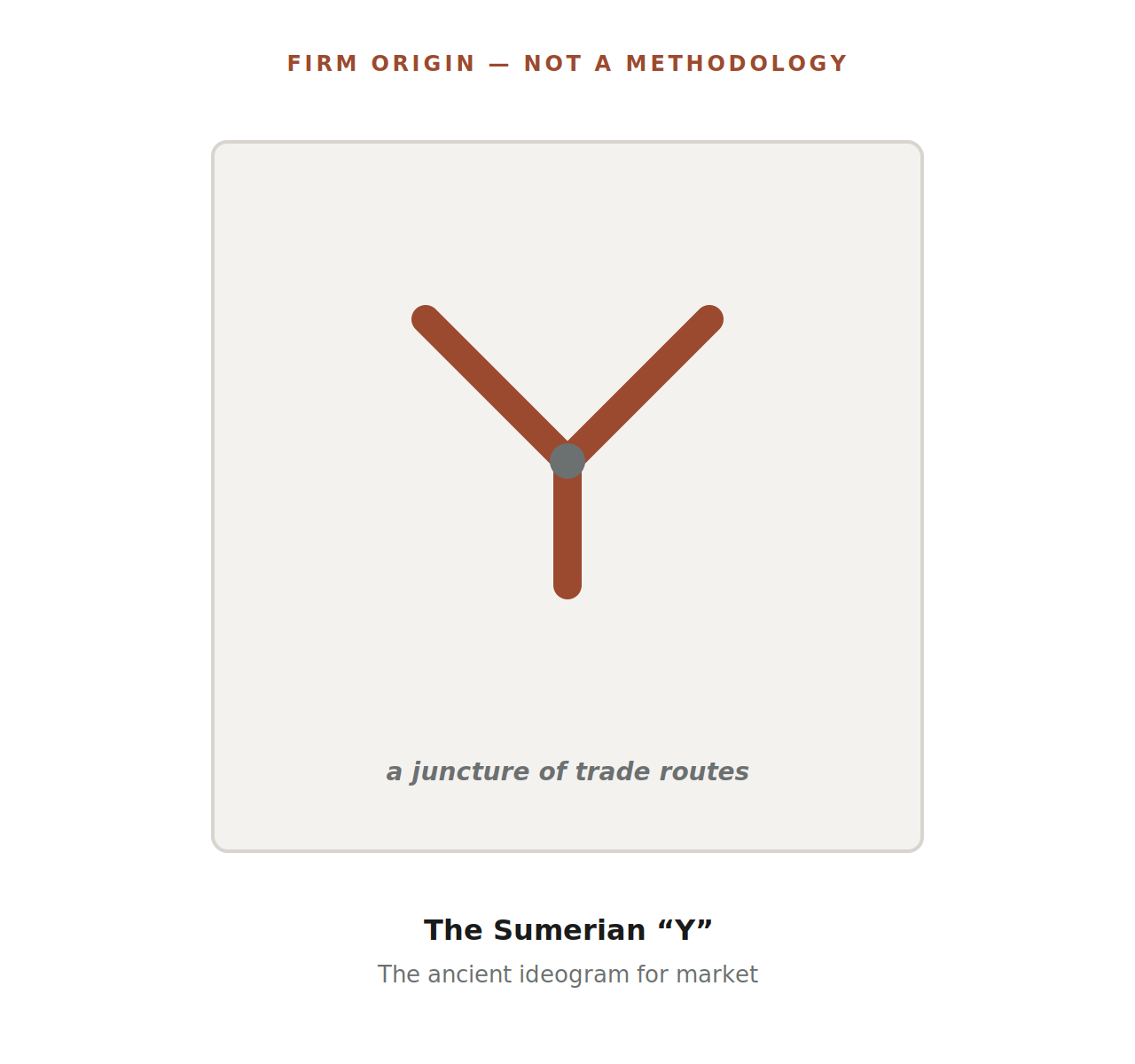
The Sumerian ideogram for market — a Y — is discussed by Lewis Mumford in The City in History (p. 72), drawing on S.N. Kramer's translations of Sumerian sources. Mumford writes only that the sign "would indicate perhaps" that the market was already understood as a juncture of trade routes — a hedge worth keeping, not a settled claim.
This is the symbolic root of People · Commerce · Place: Hoffman Strategy Group's extension of that reading, from a market-crossroads into the broader intersection of people, commerce, and place. That extension is original to Jerry Hoffman. The ideogram itself, and Mumford's reading of it, are not — they sit one level behind the framework, closer to a firm-history piece than an analytical tool.
Why an Origin Story, Not a Diagnostic Tool
The other five Credibility-tier frameworks document how Hoffman Strategy Group evaluates a site — the triggers, the mechanics, the sequencing. This one documents why the firm looks at sites that way in the first place. It carries no scoring logic and no diagnostic criteria of its own. Its job is to explain the instinct underneath all five of the others.
That's also why the Y is our why. Six frameworks, one question underneath every one of them: why does commerce happen where it happens? The other five answer it with rigor — data, thresholds, sequencing. This one explains why HSG bothered to ask the question in the language of an ancient trade symbol in the first place.
Before founding Hoffman Strategy Group in 2012, Jerry Hoffman spent nearly two decades building and applying economic models as decision-making frameworks across energy, healthcare, micro-enterprise finance, and public-sector systems. The intersection of people, commerce, and place wasn't something he discovered in real estate — it was the constant he'd already found across every field he'd worked in. Real estate became the arena where that intersection is most visible, not the field that invented it.
An ancient, cross-cultural symbol of exchange fit that throughline in a way a real-estate-specific image couldn't have.
Where It Sits in the Work
People · Commerce · Place is the organizing framework; the Sumerian "Y" is the symbolic root beneath it — the intersection logic that Village Bundle Programming ultimately operationalizes at the site and bundle scale. This completes the set of six Credibility-tier frameworks: the Five-Step Methodology Framework, People · Commerce · Place, Central Place Theory, the Trade Area Ladder, Pedestrian Economics, and this one.
See People · Commerce · Place and how Village Bundle Programming puts this to work.