
A Social Fabric Matrix Application
The Five-Step Methodology Framework is Hoffman Strategy Group's diagnostic sequence for reading a trade area. It's Jerry Hoffman's application of Social Fabric Matrix (SFM) theory — an institutional-economics framework for tracing how social beliefs and behavior translate into real-world outcomes — to the specific problem of real estate site diagnostics.
It is the process that produces Village Bundle Programming, not a separate framework alongside it: VBP is Jerry Hoffman's applied synthesis of what this process finds. The five steps are integrated rather than strictly linear — later steps actively synthesize earlier findings, which is why the fifth loops back into the first two.
The Five Steps
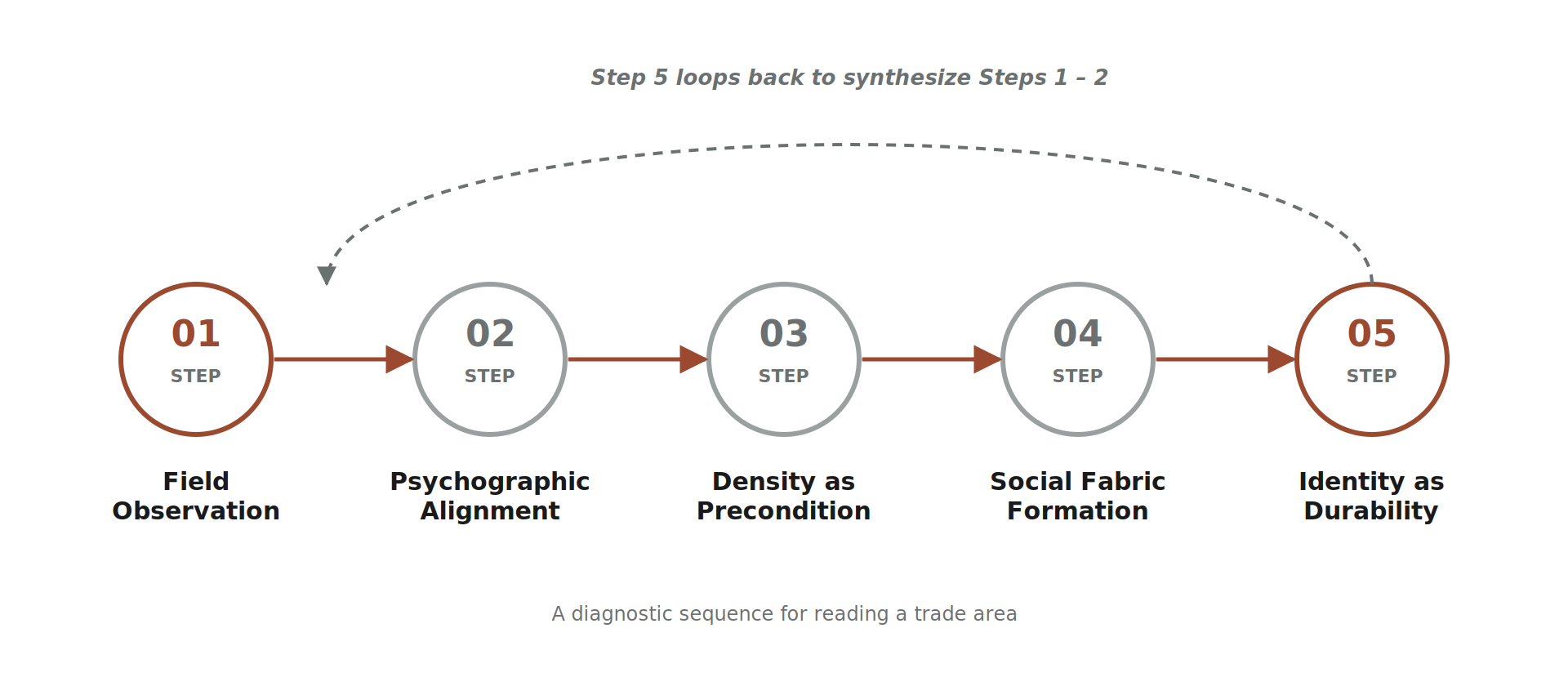
Field Observation reads a site's cultural, economic, and social milieu much as an anthropologist would — before any modeling begins.
Psychographic Alignment combines PRIZM segmentation data with that field reading to form an impression of the local cultural-social-technology framework.
Density as Precondition applies Central Place Theory — extended by HSG into the Trade Area Ladder, its own five-tier classification of trade-area hierarchy — together with modernized gravity and distance-decay modeling, against trade-area geography and consumer spending behavior. Together, these determine how each use in the village bundle gets sized, positioned, and sequenced: residential, retail, restaurants, grocery, hotels, wellness, and the rest.
Social Fabric Formation carries that modeling into pricing structure — rents, retail sales per square foot, absorption velocity — the performance metrics that feed directly into the RLV/ROM valuation engine.
Identity as Durability loops back to the cultural and psychographic findings from Steps 1 and 2 to build the development's identity, reflecting the area's strong cultural-social-economic identity while also appealing to visitors and people moving to the area.
Connection to Village Bundle Programming:
This is the connective tissue across HSG's entire IP stack, not one piece among others: Step 3 is where Central Place Theory and the Trade Area Ladder get operationalized into a village bundle's use mix; Step 4's rent, sales-per-square-foot, and absorption findings are the direct inputs to VBP's RLV/ROM quantification engine; Pedestrian Economics is the operating mechanism that converts the resulting bundle into real foot traffic and spend. Theoretical foundation, diagnostic process, and financial engine are one connected arc.
See how this becomes Village Bundle Programming.
See Central Place Theory, one of the frameworks Step 3 operationalizes.
Back to the six frameworks.
Proven at Scale
The real test of this framework isn't a citation — it's application. The Five-Step sequence and the Social Fabric Matrix diagnostic behind it have shaped major developments across the U.S. — Riverton in Sayreville, New Jersey (North American Properties, since acquired by Jamestown); Avenue One in Omaha, Nebraska (underwritten by D.A. Davidson); Utah City; The District at Clifton Heights in Cincinnati (Trinitas Ventures); and The Half in Oklahoma City, where HSG's economic-impact analysis supported a successful application under the Oklahoma Tourism Development Act — working alongside capital partners and owners including McWhinney, Neal Land Ventures, Starwood, Brookfield, The Irvine Company, Pacific Retail, Peterson Companies, and Nuveen.
(See the full record on Outcomes.)
The Five-Step Methodology Framework is Jerry Hoffman's original application of Social Fabric Matrix theory to real estate site diagnostics. Village Bundle Programming, People·Commerce·Place, the trade area ladder, Central Place Theory applied to modern trade areas, and Pedestrian Economics are original methodologies of Jerry Hoffman, attributed to Hoffman Strategy Group. The Sumerian "Y" is a historical ideogram documented by Lewis Mumford, drawing on S.N. Kramer's translations — see the dedicated Sumerian "Y" document for its extension into HSG's organizing framework.