
Nearly a Century of Economic Geography, Made Operational at the Site Level
Central Place Theory holds that a site functions as a central place — a location that supplies goods and services to the surrounding trade area it serves. Walter Christaller established the theory in 1933; David Huff later added a gravity model with distance decay, formalizing how a site's pull weakens the farther a customer has to travel. This is Jerry Hoffman's applied extension of that foundation — not a reinvention of it — to real estate trade-area diagnostics.
How HSG Applies It
This is the theoretical foundation underlying the trade-area diagnostics applied at Reagan Ranch, Utah City, and other active engagements — not a separate exercise from Village Bundle Programming, but the layer underneath it. It's operationalized specifically in Step 3 of the Five-Step Methodology Framework (Density as Precondition), where trade-area geography and consumer spending behavior are modeled — alongside the Trade Area Ladder and the Huff gravity model — into the specific implications for each use in the bundle: residential, retail, restaurants, grocery, hotels.
See the Five-Step Methodology Framework.
See the Trade Area Ladder.
See the core Village Bundle Programming methodology.
Back to the six frameworks.
The Two Governing Concepts
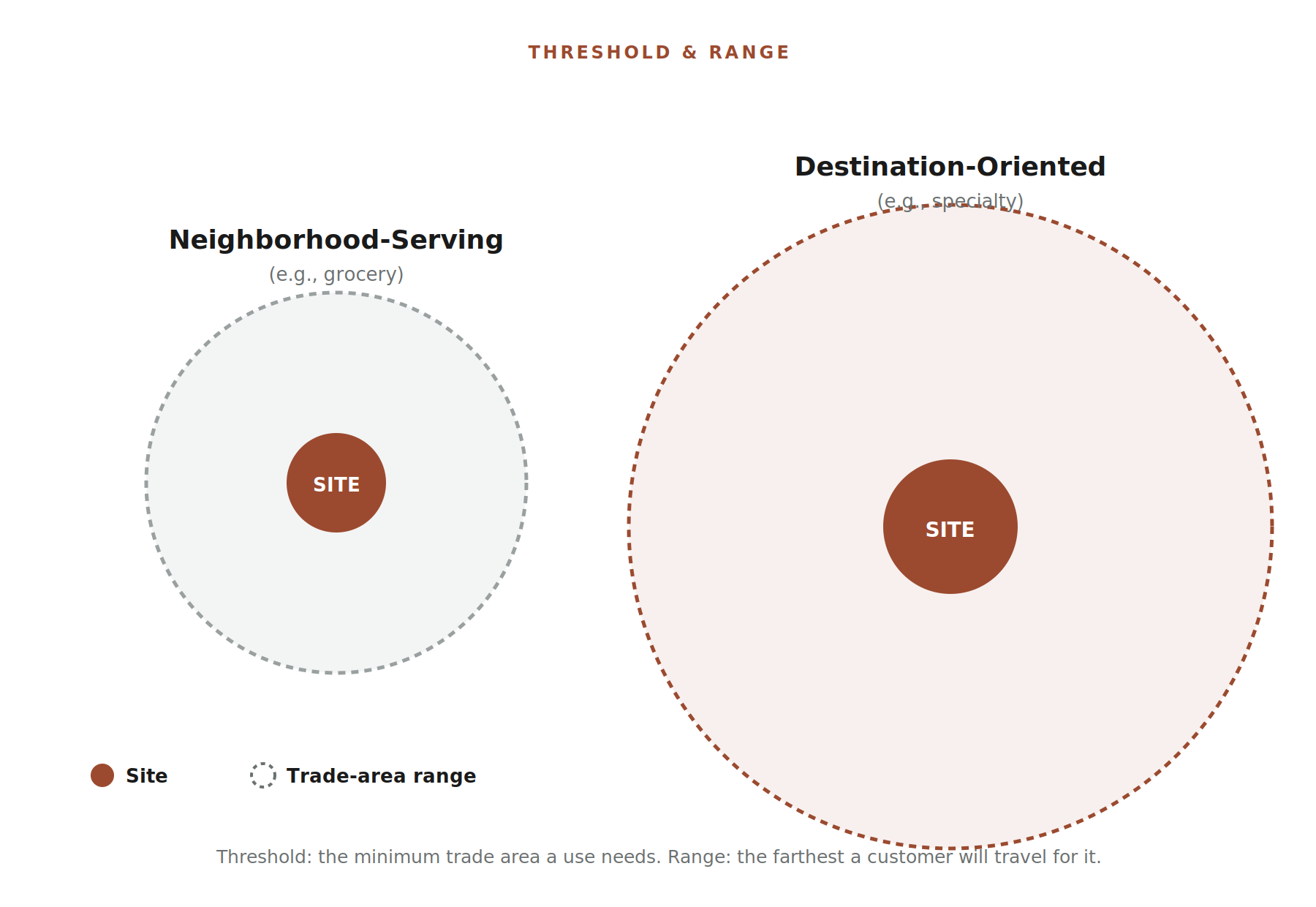
Threshold — the minimum trade area, population and spending, a use needs to be viable at all. Below it, the use doesn't get built.
Range — the farthest distance a customer will travel for that use. Beyond it, a competing center captures the trip instead.
Every use in a village bundle has its own threshold and range. Grocery has a small threshold and a short range — it needs to be close and it needs relatively few households to work. A destination anchor has a large threshold and a long range — it can draw from much farther out, but it needs far more trade area behind it to justify the investment.
Central Place Theory was established by Walter Christaller (1933) and extended by August Lösch and David Huff; its application to real estate trade-area diagnostics is Jerry Hoffman's own. People·Commerce·Place, Village Bundle Programming, the trade area ladder, Pedestrian Economics, and the Five-Step Methodology Framework are original methodologies of Jerry Hoffman, attributed to Hoffman Strategy Group. The Sumerian "Y" is a historical ideogram documented by Lewis Mumford, drawing on S.N. Kramer's translations — see the dedicated Sumerian "Y" document for its extension into HSG's organizing framework.