
Christaller's City Hierarchy, Extended Into a Working Classification
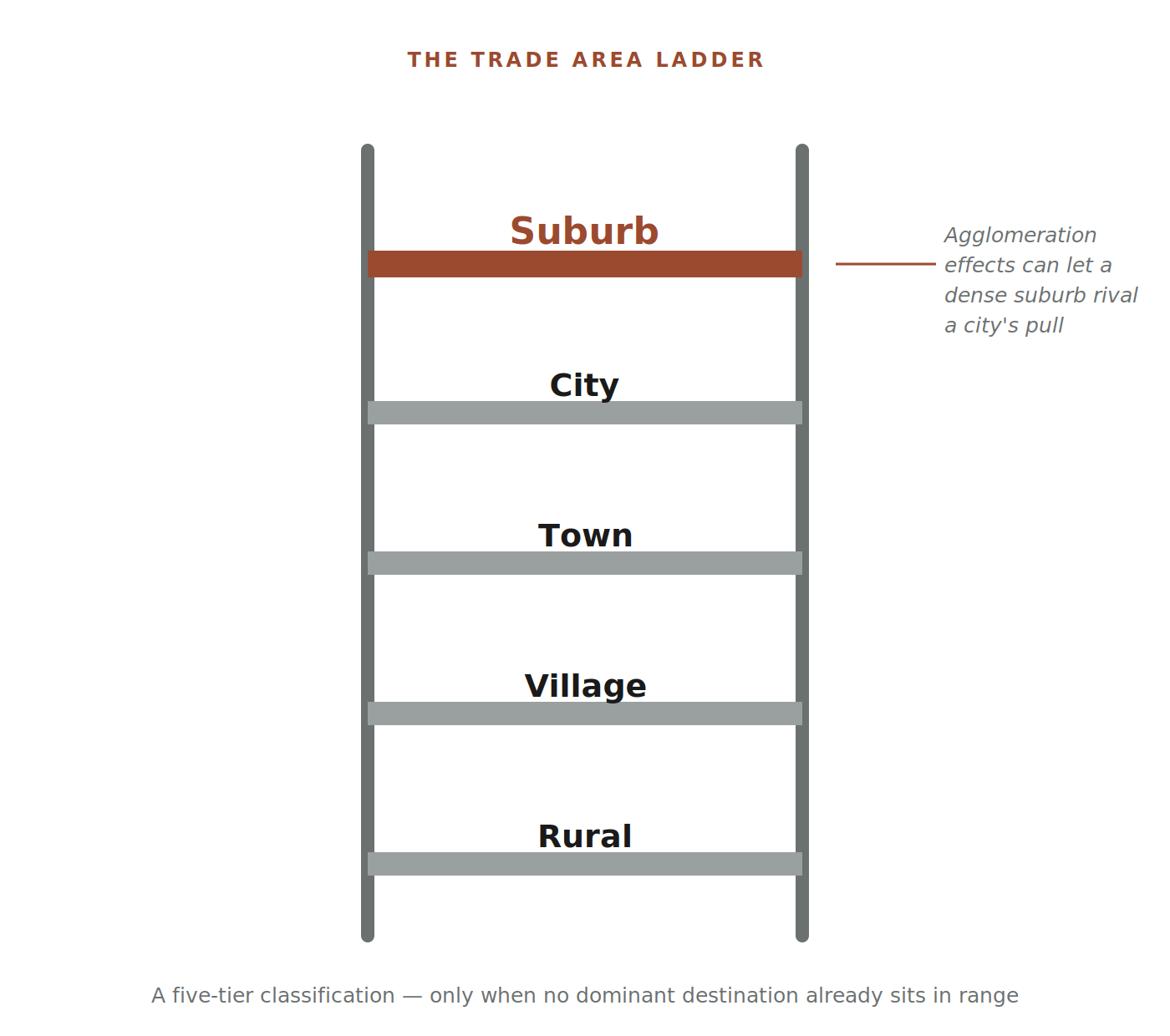
Central Place Theory establishes that centers form a hierarchy — each tier serving a larger trade area with a broader range of goods and services than the one below it. The Trade Area Ladder is Hoffman Strategy Group's extension of that hierarchy into a working, five-tier classification — rural, village, town, city, suburb — applied alongside Central Place Theory in the same trade-area diagnostics at Reagan Ranch, Utah City, and other active engagements.
Why Suburb Sits at the Top
Classical Central Place Theory would put a city above a suburb by default. HSG's ladder doesn't — and that's deliberate, not an inconsistency. Modern economic geography research has shown that agglomeration effects can let a dense, affluent suburb rival or exceed a traditional city center's pull. The ladder reflects that modern reality rather than the 1933 original on its own.
A Necessary Caveat
That elevation isn't unconditional, and reading it as a green light on its own is the most common way to misapply this ladder. A suburb's ability to rival a city's pull holds only when no dominant destination already sits inside its range — the same range concept from Central Place Theory. A well-positioned suburb-tier site next to a large enough competing destination doesn't get promoted up the ladder on tier alone; it gets repositioned to complement that destination instead, capturing frequency and dwell rather than competing for draw. Ladder tier and range have to be read together — tier tells you the site's potential ceiling, range tells you whether a competitor is already standing in the way of it.
How HSG Applies It
The ladder isn't a standalone classification exercise — it's read alongside Central Place Theory and the Huff gravity model in Step 3 of the Five-Step Methodology Framework (Density as Precondition), where a site's tier and its distance-decay profile together shape the implications for each use in a village bundle. A site's ladder tier changes what threshold and range mean for it in practice: a village-tier site and a city-tier site can face the same threshold number for a given use and mean two very different things by it.
See Central Place Theory, for threshold and range, the Five-Step Methodology Framework, the core Village Bundle Programming methodology. Back to the six frameworks.
The Trade Area Ladder is Jerry Hoffman's extension of Walter Christaller's city-hierarchy concept to real estate trade-area diagnostics. People·Commerce·Place, Village Bundle Programming, Central Place Theory applied to modern trade areas, Pedestrian Economics, and the Five-Step Methodology Framework are original methodologies of Jerry Hoffman, attributed to Hoffman Strategy Group. The Sumerian "Y" is a historical ideogram documented by Lewis Mumford, drawing on S.N. Kramer's translations — see the dedicated Sumerian "Y" document for its extension into HSG's organizing framework.