
Customer Profiling & Store Supportability
We Already Know the Markets You're Evaluating
Most growth plans rest on a customer profile that was written rather than measured — a description of who a brand believes it serves, carried forward for years because nothing ever tested it. Sites get picked on instinct, on a broker's map, or on where the last few stores happened to work.
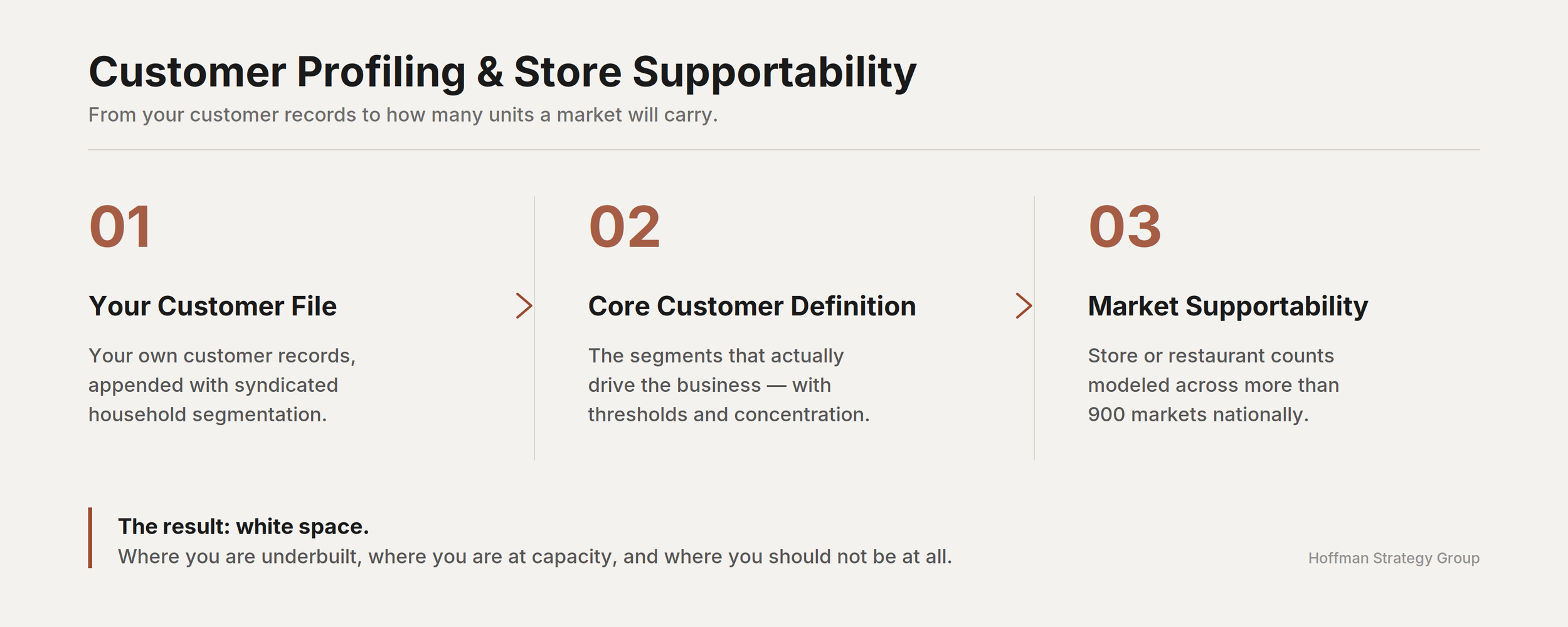
We start from your customer records instead. Hoffman Strategy Group appends syndicated household segmentation to your own customer file, then works out which segments actually drive the business rather than which ones simply appear in it. That produces a core customer definition grounded in behavior. From there the question becomes arithmetic: if those are your customers, how many live in each market in the country — and how many units will each market support?
What You Get
A core customer definition. Derived from your records, expressed in segmentation terms that can be located geographically anywhere in the United States.
Thresholds and concentration measures. The quantitative test for whether a market carries enough of your customer to matter, and how heavily concentrated they are relative to the national base.
Market-level supportability. Store or restaurant counts modeled across more than 900 markets nationally. Not a ranked wish list — a defensible estimate of how many units each market will carry.
White space. Where you are under-built, where you are at capacity, and where you should not be at all.
124 Markets, 37 States
Before we form an opinion about a market, we spend time in it. We drive the residential streets and the main corridors. We walk the centers. We eat in the restaurants and talk with the people running them — owners, chefs, store managers.
That's how you learn what a data pull won't tell you: why one corridor works and the one two miles away doesn't, where people actually go and when, what holds the local economy together.
We do it because owners and developers hire us to program what gets built. Utah City in Vineyard, Utah. Avenue One in Omaha. The Half in Oklahoma City. Reagan Ranch in Colorado Springs. Leal in Eastvale, California. Riverton in Sayreville, New Jersey. A mall redevelopment in White Plains, New York.
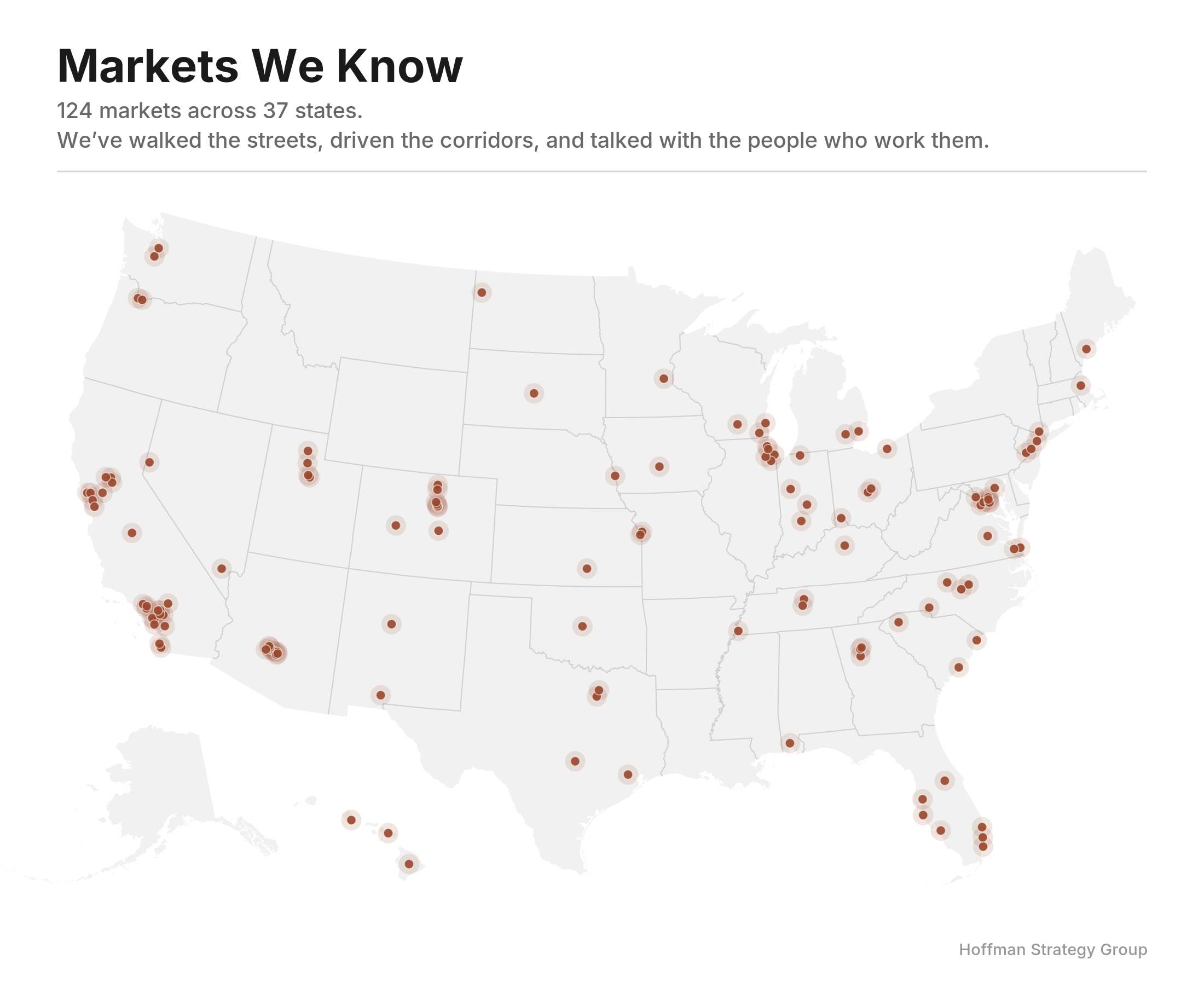
Markets we've studied on behalf of the owners and developers building there.
So when we look at a market for you, we aren't starting from zero. And we can tell you more than whether enough of your customers live there. We can tell you whether a particular site inside it will work.
Why It Holds Up
Two things separate this from a demographic report.
It starts with your data. Syndicated segmentation applied to a generic trade area describes a place. Applied to your customer file, it describes your business.
And supportability is modeled, not asserted. The output is a number your real estate committee can defend — one that stands up when a landlord, a lender, or a board asks how it was derived.
Proven Across a Decade
Ollie's Bargain Outlet. Four engagement cycles spanning two generations of the underlying segmentation system as the chain scaled nationally.
Johnny Was. Customer profiling extended into site-level sales forecasts for approximately 150 candidate locations.
Two categories, a decade of retail cycles, and a client who has come back four times.
Talk to Us About Your Markets
If you're building a growth plan, defending one to a board, or trying to work out whether a market is real, that's the conversation.
Contact us to discuss your real estate strategy.
The application layer described here — appending segmentation to client customer records, deriving core customer definitions and thresholds, and modeling store and restaurant supportability — is Hoffman Strategy Group's proprietary methodology. PRIZM Premier is the licensed intellectual property of Claritas, LLC. PRIZM is a registered trademark of Claritas, LLC.